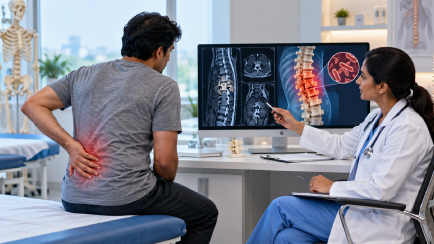
Artificial Disc Replacement vs Spinal Fusion: How Do Surgeons Choose?
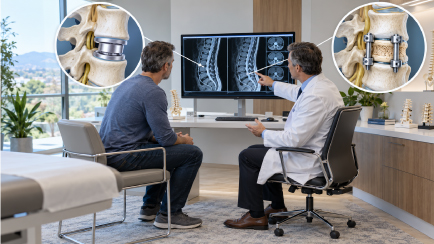
When neck or back symptoms persist, surgical discussions may include artificial disc replacement or spinal fusion. Both procedures address selected spinal problems, but they have different aims and suitability requirements.
In artificial disc replacement vs Spinal fusion, the decision depends on the diagnosis, spinal level, bone quality, stability and condition of surrounding joints. A procedure that suits one patient may be inappropriate for another.
The first question is whether surgery is indicated at all. An abnormal MRI finding alone does not establish that an operation will address the symptoms.
What Does Artificial Disc Replacement Involve?
Artificial disc replacement removes a problematic disc and inserts an implant designed to allow movement at that spinal level.
It may be considered for selected cervical, or neck, conditions and selected lumbar, or lower-back, conditions. These are separate clinical situations with different selection criteria.
Preserving movement is a treatment goal, but an artificial disc does not recreate every feature of a healthy natural disc. Suitability requires assessment beyond a preference to avoid fusion.
What Does Spinal Fusion Involve?
Spinal fusion aims to join two or more vertebrae so they heal into a solid unit. Bone graft material is used, sometimes with implants such as screws, rods, plates or cages.
Fusion limits movement at the treated level. It may be considered when stabilisation is required or as part of surgery addressing nerve compression or other structural problems.
Ask which part of the operation treats the symptoms and why stabilisation is necessary in your case.
Artificial Disc Replacement vs Spinal Fusion: Key Differences
| Consideration | Artificial disc replacement | Spinal fusion |
| Main mechanical goal | Preserve movement at the treated level | Stop movement at the treated level |
| Main implant or material | Artificial disc | Bone graft, often with supporting implants |
| Selection considerations | Joint condition, stability and bone quality | Diagnosis and need for stabilisation |
| Healing considerations | Recovery and implant integration | Recovery and formation of a bone fusion |
| Possible later issues | Implant-related problems or further surgery | Failure to fuse or further surgery |
These differences explain the procedures, but they do not establish which is appropriate without clinical assessment.
Which Findings Influence the Decision?
Matching symptoms to the diagnosis
The surgeon considers pain distribution, examination findings, weakness or altered sensation, and imaging. The findings should help explain the symptoms being targeted.
Ask whether the main goal is relieving arm or leg symptoms, addressing neck or back pain, improving stability or preventing neurological deterioration. These goals are not interchangeable.
Bone quality, joints and stability
Osteoporosis, substantial facet-joint disease, deformity or instability may make disc replacement unsuitable. The number and location of affected levels also matter.
A disc implant addresses the disc space; it does not correct every source of spinal pain. Ask whether surrounding structures could influence the expected outcome.
Neck and lower-back differences
Advice about cervical disc replacement should not automatically be applied to lumbar surgery. Lumbar replacement requires careful identification of an appropriate disc-related pain problem and assessment of other structures.
When reading about artificial disc replacement vs spinal fusion, check whether the information concerns the same spinal region and diagnosis as yours.
Does Persistent Pain Always Mean Surgery Is Needed?
No. Some patients continue with non-surgical management even when symptoms have lasted a long time. Surgery requires an indication, rather than simply evidence that several treatments have been tried.
The discussion should review previous physiotherapy, medicines and other treatment where relevant. Progressive neurological findings may change the timing and purpose of intervention.
Ask what is likely to happen with continued observation and what findings would require earlier reassessment.
What Risks Should You Discuss?
Both procedures carry risks, including infection, bleeding, nerve injury, persistent symptoms and further surgery.
Fusion has additional concerns such as failure of the bones to unite. Disc replacement has implant-related risks and may require revision if problems develop.
Risks also vary by approach and spinal region. For example, surgery through the front of the neck may cause swallowing difficulties. Ask about risks relevant to the actual operation proposed.
How Does Recovery Affect the Choice?
Recovery depends on the operation, health, symptoms and work demands. Preserving movement does not mean unrestricted activity immediately after surgery.
Discuss walking, lifting, driving, physiotherapy and returning to work. Ask which restrictions are temporary and what findings will guide progression.
Bring a description of your daily tasks so advice covers your needs rather than only a general recovery timetable.
Conclusion
Artificial disc replacement vs spinal fusion is a decision about diagnosis and suitability. A review with Spine Care can clarify whether surgery is indicated, which findings support the recommendation and what improvement is reasonable to expect.
FAQs
Does disc replacement remove every cause of back or neck pain?
No. It addresses selected disc-related problems. Other joints, nerves or structures may contribute to symptoms and influence the outcome.
Does fusion stop the whole spine from moving?
No. Fusion limits movement at the treated level or levels. The effect depends on the location and extent of the operation.
Can I choose disc replacement solely to preserve movement?
Preference matters, but the procedure must also be medically suitable. Bone quality, stability, joint disease and diagnosis guide the decision.